Affiliate Disclosure: PadelGuideUS participates in the Amazon Associates program and other affiliate programs. We may earn a commission when you purchase through our links, at no extra cost to you. Our recommendations are always editorially independent. Learn more.
Two Racket Sports, One Big Question
Walk into any gym, park, or recreation center in the US right now and you’ll find pickleball courts where tennis courts used to be. Some tennis players are furious about it. Others have quietly switched. Most are curious but haven’t tried it yet.
If you’re a tennis player wondering what pickleball actually is — or a pickleball player wondering whether tennis is worth learning — this is the comparison you need. Not a shallow “pickleball is easier” take, but a real side-by-side breakdown of what’s actually different, what transfers between the two sports, and which one makes sense for where you are right now.
And if you’ve been hearing about padel — the third racket sport that’s growing even faster than pickleball — we’ll cover that too at the end.
The Quick Answer
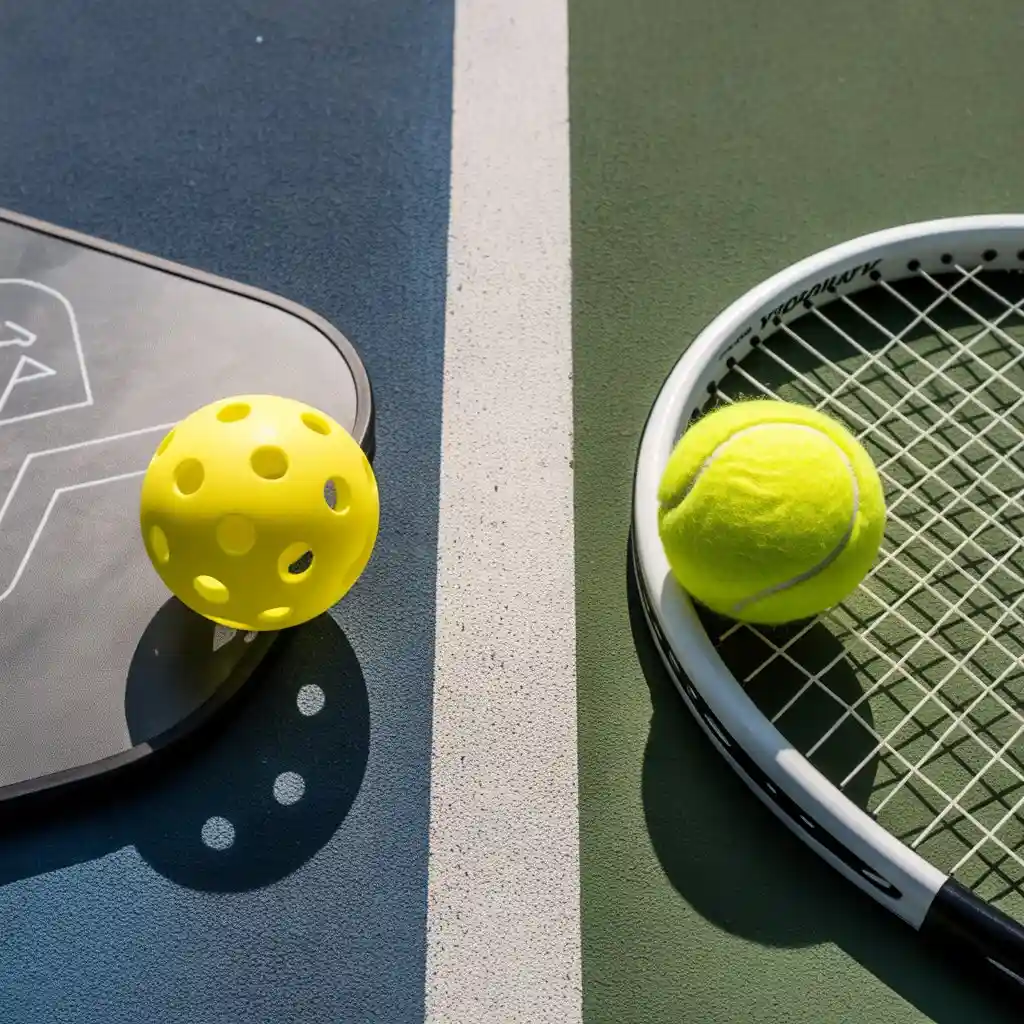
Pickleball is played on a smaller court with a solid paddle and a plastic wiffle ball. Points are fast, the learning curve is gentle, and the social scene is unmatched. It’s the most accessible racket sport in the US.
Tennis is played on a full-size court with a strung racket and a felt ball. The game rewards endurance, power, and years of technical development. It’s harder to learn but has a deeper skill ceiling.
They’re related sports — both use a net, both involve volleys and groundstrokes, both reward good footwork — but the playing experience is genuinely different in ways that matter.
Court Size
This is the most immediately obvious difference and it changes everything about how the game is played.
A standard tennis court is 78 feet long and 36 feet wide for doubles — roughly the size of a doubles badminton court multiplied by four. A pickleball court is 44 feet long and 20 feet wide. You could fit four pickleball courts inside one tennis court.
The smaller court is why pickleball is more accessible to older players and beginners. You cover less ground per point, which means less running, less endurance requirement, and less physical punishment on joints. It’s also why doubles pickleball — the dominant format — is so social. You’re physically close to your partner and opponents throughout every rally.
Tennis’s larger court rewards power and endurance. A baseline rally in tennis involves covering 15-20 feet side to side repeatedly. In pickleball, the same rally might involve shuffling 4-6 feet. Different physical demands entirely.
| Pickleball | Tennis | |
|---|---|---|
| Court length | 44 ft | 78 ft |
| Court width (doubles) | 20 ft | 36 ft |
| Net height (center) | 34 inches | 36 inches |
| Kitchen / no-volley zone | 7 ft from net | None |
The Net and the Kitchen
Two structural differences that define each sport’s tactics.
The pickleball net sits at 34 inches in the center — 2 inches lower than tennis. That sounds minor but it meaningfully affects shot selection, particularly on drives and dinks.
More significant is the kitchen — the non-volley zone in pickleball that extends 7 feet from the net on both sides. You cannot volley (hit the ball in the air) while standing in the kitchen. This single rule creates the most distinctive element of pickleball strategy: the soft game at the kitchen line. Elite pickleball is largely a game of who controls the kitchen, who can sustain a dink rally without making an error, and who can create the opportunity to attack.
Tennis has no equivalent zone. You can volley from anywhere including right at the net. This makes tennis net play more aggressive and less strategic by comparison — a good tennis player at the net is simply putting away shots, not engaging in extended soft exchanges.
Scoring
Both sports use similar-sounding terminology but the scoring systems are genuinely different.
Pickleball uses side-out scoring. You can only score a point when your team is serving. Games are typically played to 11 points, win by 2. In doubles, both players on the serving team get to serve before the serve passes to the opponents. This creates longer games than the score suggests — you can be winning 10-9 and lose the next 5 points without scoring.
Tennis uses a 15-30-40-game structure within sets, typically best of 3 or best of 5 sets. The scoring is more complex but creates a different psychological dynamic — a single break of serve can define an entire set.
One practical difference: pickleball games finish faster. A recreational doubles match to 11 takes 15-20 minutes. A recreational tennis set takes 45-60 minutes. If you have limited time or want to play multiple games in an hour, pickleball fits that lifestyle better.
Equipment — Paddle vs Racket
This is where pickleball players switching to tennis face the biggest adjustment, and where tennis players picking up pickleball have a significant advantage.
Tennis rackets are strung, typically weighing 280-310 grams. The strings create a trampoline effect that generates power and topspin. Developing a good tennis serve alone takes months of practice. The technical demands of a strung racket — controlling spin, swing path, string tension — are significantly higher than a solid paddle.
Pickleball paddles are solid with no strings, typically weighing 200-250 grams. The lighter weight and solid face reward compact, controlled swings over full-extension power shots. There’s no string tension to manage, no spin generation through brushing technique. The learning curve is dramatically shorter.
Tennis players picking up a pickleball paddle immediately notice how light it feels and how the ball comes off the face differently than strings. The adjustment to a solid face takes a few sessions. In the other direction, a pickleball player picking up a tennis racket faces a bigger adjustment — the swing mechanics, serve, and topspin groundstrokes are fundamentally different skills.
Physical Demand
Honest answer: tennis is significantly more physically demanding than pickleball, and that’s by design.
Tennis requires explosive lateral speed across a large court, overhead serving mechanics that load the shoulder and elbow, and sustained aerobic endurance over long matches. It’s a sport that gets harder on the body as you age — rotator cuff injuries, tennis elbow, and knee stress are common.
Pickleball is lower impact. The smaller court reduces the distance covered per point. The underhand serve eliminates the overhead shoulder load. The soft game at the kitchen line rewards touch and placement over power and speed. Many players who had to stop playing tennis due to joint or shoulder issues have found pickleball as a viable, lower-impact alternative.
This isn’t a knock on pickleball — it’s genuinely why the sport has grown so fast among the 50+ demographic in the US. Lower impact doesn’t mean easier or less competitive. Elite pickleball at 4.5+ level is physically demanding. But the barrier to playing regularly, comfortably, and without next-day joint pain is significantly lower than tennis.
Cost
Both sports have similar entry-level costs for equipment but differ significantly in court access fees.
Tennis equipment: A decent beginner racket runs $60-150. Balls are $4-8 for a can of three. Proper tennis shoes are $80-130.
Pickleball equipment: A decent beginner paddle runs $40-100. Balls are $10-15 for a pack of six. Court shoes are $70-130.
The bigger difference is courts. Tennis courts are widespread and often free at public parks — but demand is increasing and many municipalities are converting underutilized tennis courts to pickleball. Indoor tennis club memberships typically run $100-200 per month.
Pickleball courts are multiplying rapidly. Many gyms, recreation centers, and dedicated pickleball facilities offer drop-in sessions for $5-15. The lower barrier to finding an affordable game is a meaningful advantage.
Learning Curve
Pickleball wins here and it’s not particularly close.
Most adults can play a real competitive pickleball game within their first or second session. The underhand serve is forgiving. The smaller court removes endurance as a factor for beginners. The dink game at the kitchen line rewards patience and placement — skills that transfer from any racket background.
Tennis takes longer. A functional tennis serve alone takes weeks of consistent practice to develop. Groundstroke mechanics with spin, footwork patterns across a full court, and the physical fitness requirements all create a steeper initial curve.
For tennis players picking up pickleball: you’ll be competitive within a session or two. Your groundstroke instincts, net game, and footwork all transfer directly. The main adjustments are the shorter swing, the kitchen rule, and learning to dink.
For pickleball players picking up tennis: you’ll understand the game quickly but the technical development takes longer. Your soft game, court awareness, and doubles communication are genuine assets. Your serve and groundstroke mechanics will need real work.
Are Pickleball and Tennis Courts the Same?
No — but they can share the same space. A standard tennis court can be converted to pickleball by adding temporary lines and lowering the net, and many facilities do exactly this. You can fit four pickleball courts on one tennis court.
This is the source of the well-documented conflict between tennis and pickleball communities at public parks. Both sports are competing for the same physical space. In most US metros the trend is toward more pickleball courts at the expense of tennis, which has led to real friction at city recreation departments.
If you want to try pickleball and already have access to a tennis court — you can play. Bring tape or chalk for temporary lines, lower the net to 34 inches in the center if possible, and use the doubles sidelines as your boundaries.
Are Pickleball Shoes and Tennis Shoes the Same?
Similar but not identical. Hard-court tennis shoes work for pickleball — both are lateral-support court shoes with non-marking soles. If you already own good hard-court tennis shoes, use them for pickleball.
The differences that matter for dedicated players: pickleball outsoles are optimized for hard court surfaces specifically, pickleball involves more frequent toe-loading at the kitchen line which requires reinforced toe caps, and pickleball’s shorter explosive movements favor lighter shoes than baseline tennis demands.
For a player who plays both sports, hard-court tennis shoes are the best crossover option. Our best shoes for pickleball and padel guide covers the specific shoes that work well across court sports.
Which Sport Should You Play?
Play pickleball if: You want to be playing competitive points within your first session. You want a social sport that’s easy to organize around work and family schedules. You have joint concerns or want lower-impact exercise. You want the fastest-growing recreational sport community in the US.
Play tennis if: You want a sport with a deep technical skill ceiling that rewards years of development. You enjoy the physical challenge of covering a full court. You want to play singles competitively. You’re willing to invest the time in proper technique development.
Play both if: You already play one and want to add the other. The skills transfer more than most players expect. Tennis players become competitive pickleball players within weeks. Pickleball players who stick with tennis develop solid court instincts faster than beginners.
What About Padel?
If you play pickleball and enjoy the doubles strategy and enclosed-court feel, padel is worth knowing about. It’s the fastest-growing racket sport in the world — bigger than pickleball globally — and it’s now in every major US metro.
Padel is played in an enclosed glass and mesh court slightly larger than a pickleball court. The walls are in play, like squash. It’s always doubles. The scoring is identical to tennis. The racket is solid with no strings, like a pickleball paddle but heavier.
Pickleball players pick up padel faster than almost anyone — your lateral quickness, kitchen instincts, and doubles communication all transfer directly. The main adjustments are learning to use the glass walls and adapting to a heavier racket.
Our padel vs pickleball comparison goes deeper on exactly what transfers and what doesn’t. If you’re ready to try padel equipment, the padel equipment for beginners guide covers everything you need to start without overspending.
FAQ
What is the difference between pickleball and tennis? Smaller court, solid paddle, plastic ball, faster to learn, lower physical impact — that’s pickleball. Full-size court, strung racket, felt ball, steeper learning curve, higher endurance demand — that’s tennis. Both reward good footwork and court sense.
Is pickleball easier than tennis? Yes, meaningfully so. Most adults play competitive pickleball within a session or two. Tennis requires weeks to develop a functional serve alone. That said, elite pickleball is genuinely demanding — the skill ceiling is high.
Can you play pickleball on a tennis court? Yes. Four pickleball courts fit on one tennis court. Many facilities use temporary lines to convert. Lower the net to 34 inches at the center and use the tennis doubles sidelines as your boundaries.
Are pickleball and tennis nets the same height? No. Tennis net: 36 inches at center. Pickleball net: 34 inches at center. The 2-inch difference affects shot selection on drives and low volleys.
Can tennis players play pickleball? Yes — and they typically become competitive fast. Groundstrokes, net game, and footwork all transfer. Main adjustments: shorter swing, kitchen rule, learning to dink.
Is pickleball better than tennis for older players? Generally yes. Smaller court, no overhead serve, soft game at the kitchen — pickleball is lower impact in every meaningful way. Many players who stopped playing tennis due to joint or shoulder issues play pickleball comfortably.
What sport is growing faster — pickleball or tennis? Pickleball in the US by a wide margin — 13 million players and growing fast. Globally, padel is growing
Ready to Start Playing Padel?
Browse our full equipment guides to find the right racket and shoes before your first session.